{Data validation} ,by /example #
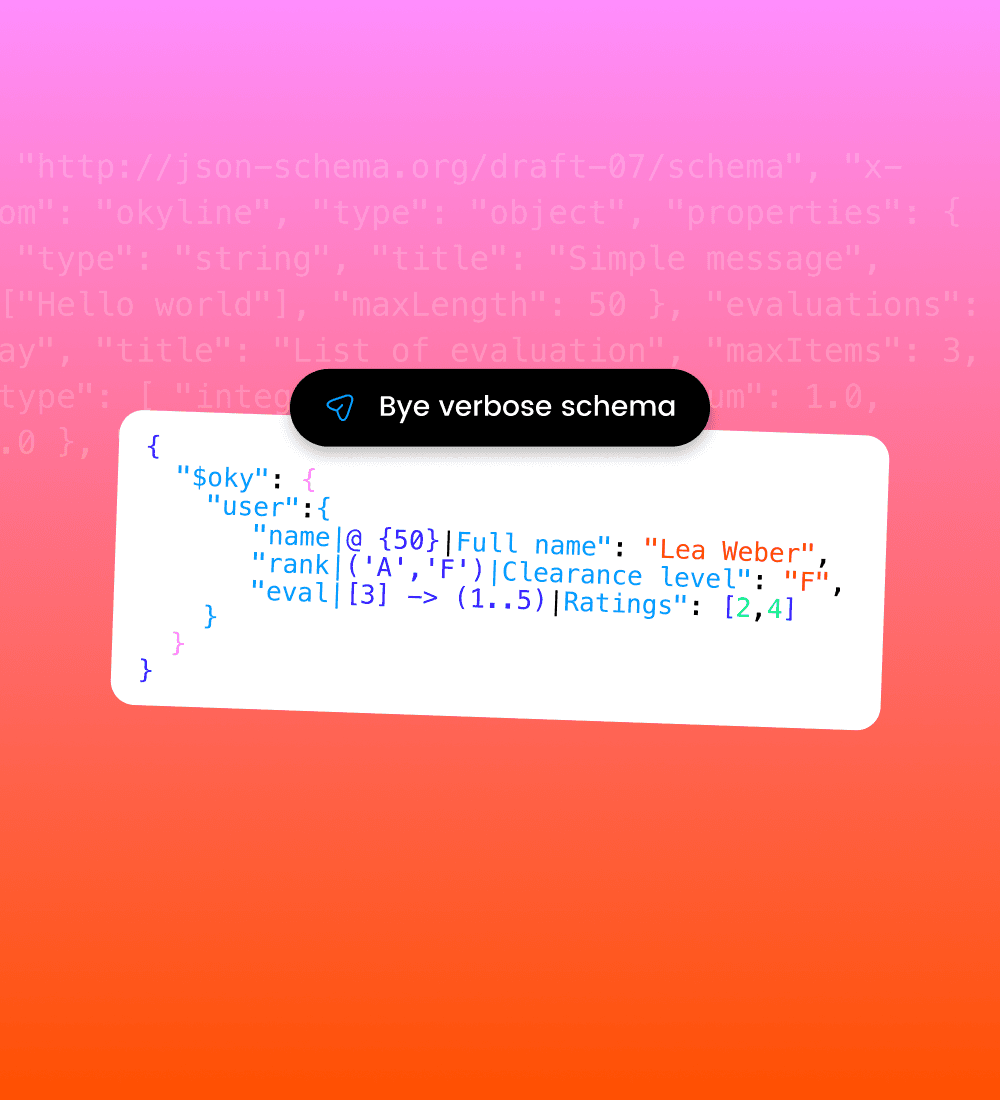
Okyline gives you readable, real-world JSON validation, powered by simple,annotated examples.
Your data never leaves your browser


5×shorter than JSON Schema
100% local, no cloud required
Compatible with your existing stack
Easy to read and write
Fast to execute
Exportable to JSON Schema
5×shorter than JSON Schema
100% local, no cloud required
Compatible with your existing stack
Easy to read and write
Fast to execute
Exportable to JSON Schema
5×shorter than JSON Schema
100% local, no cloud required
Compatible with your existing stack
Easy to read and write
Fast to execute
Exportable to JSON Schema
Data quality starts with shared understanding
However, most data models are defined too late, buried in code, impossible to align. Okyline brings design-first back into focus, with schemas that are readable, executable, and ready to share from day one.
Designed for humans
Readable syntax, close to your data. Understand it in 5 minutes, master it in one hour.
Interactive schema builder
Design and validate your schema, live, directly on your data.
JSON Schema compatible
Native export to JSON Schema (draft-07). Direct integration with OpenAPI, Ajv, Fastify, Postman...
Ultra fast execution
Tens of thousands of validations per second on a single thread. Perfect for batch processing, ETL, or critical APIs.
Designed for humans
Readable syntax, close to your data. Understandit in 5 minutes, master it in one hour.
Designed for humans
Readable syntax, close to your data. Understandit in 5 minutes, master it in one hour.
Designed for humans
Readable syntax, close to your data. Understandit in 5 minutes, master it in one hour.
Interactive schema builder
Tens of thousands of validations per second on a single thread. Perfect for batch processing,ETL, or critical APIs.
Interactive schema builder
Tens of thousands of validations per second on a single thread. Perfect for batch processing,ETL, or critical APIs.
Interactive schema builder
Tens of thousands of validations per second on a single thread. Perfect for batch processing,ETL, or critical APIs.
JSON Schema compatible
Native export to JSON Schema (draft-07). Directintegration with OpenAPI, Ajv, Fastify, Postman...
JSON Schema compatible
Native export to JSON Schema (draft-07). Directintegration with OpenAPI, Ajv, Fastify, Postman...
JSON Schema compatible
Native export to JSON Schema (draft-07). Directintegration with OpenAPI, Ajv, Fastify, Postman...
Ultra fast execution
Native export to JSON Schema (draft-07). Directintegration with OpenAPI, Ajv, Fastify, Postman...
Ultra fast execution
Native export to JSON Schema (draft-07). Directintegration with OpenAPI, Ajv, Fastify, Postman...
Ultra fast execution
Native export to JSON Schema (draft-07). Directintegration with OpenAPI, Ajv, Fastify, Postman...


{Okyline} is a game changer_
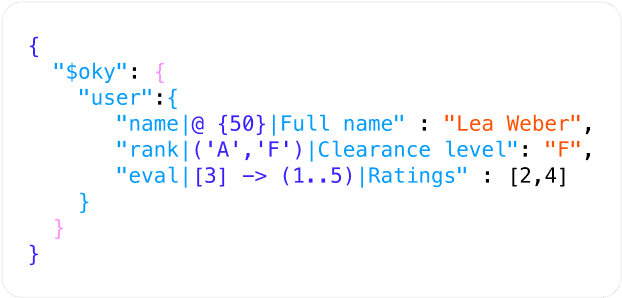
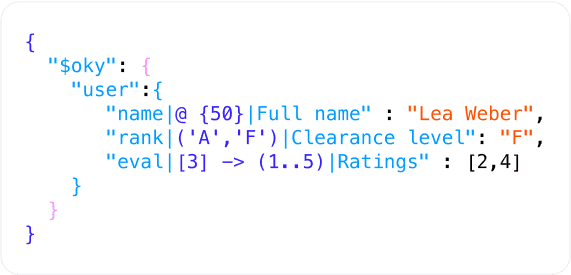
From a simple enriched JSON example, you can declare business constraints in a readable and structured format that can be immediately executed — or exported as a standard JSON schema.
Tired of writing verbose JSON Schema definitions?
What does {Okyline} brings
to your_ data validation #workflow ?
What does {Okyline} brings
to your_ data validation #workflow ?
What does {Okyline} brings
to your_ data validation #workflow ?
Design-first syntax
What it does
Add validation rules directly inside exampleJSON fields using | suffixes | labels
Real-world impact
Your examples become specs. Instantlyreadable, immediately useful.
Field-levelconstraints
What it does
@, ?, (…), {…}, ~regex~, [min,max], !, $ref, %
Real-world impact
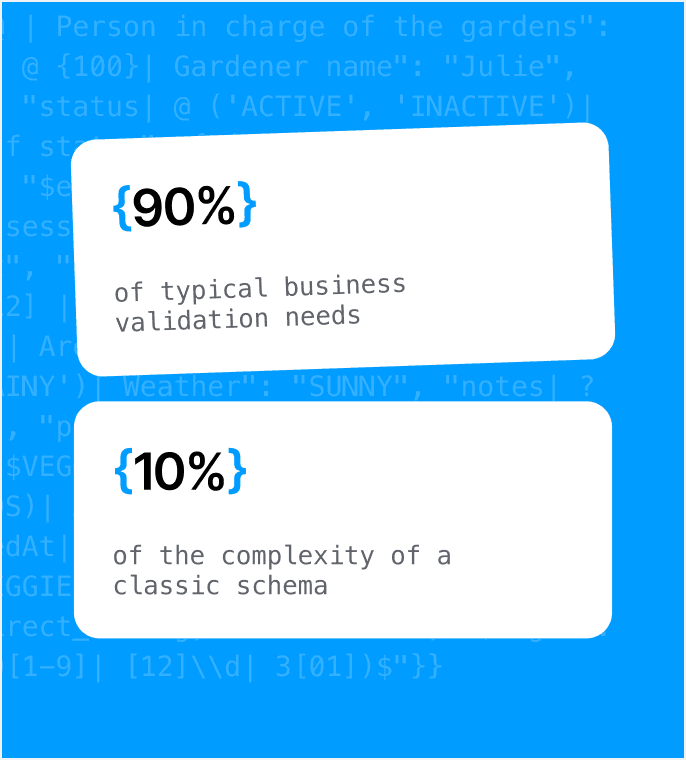
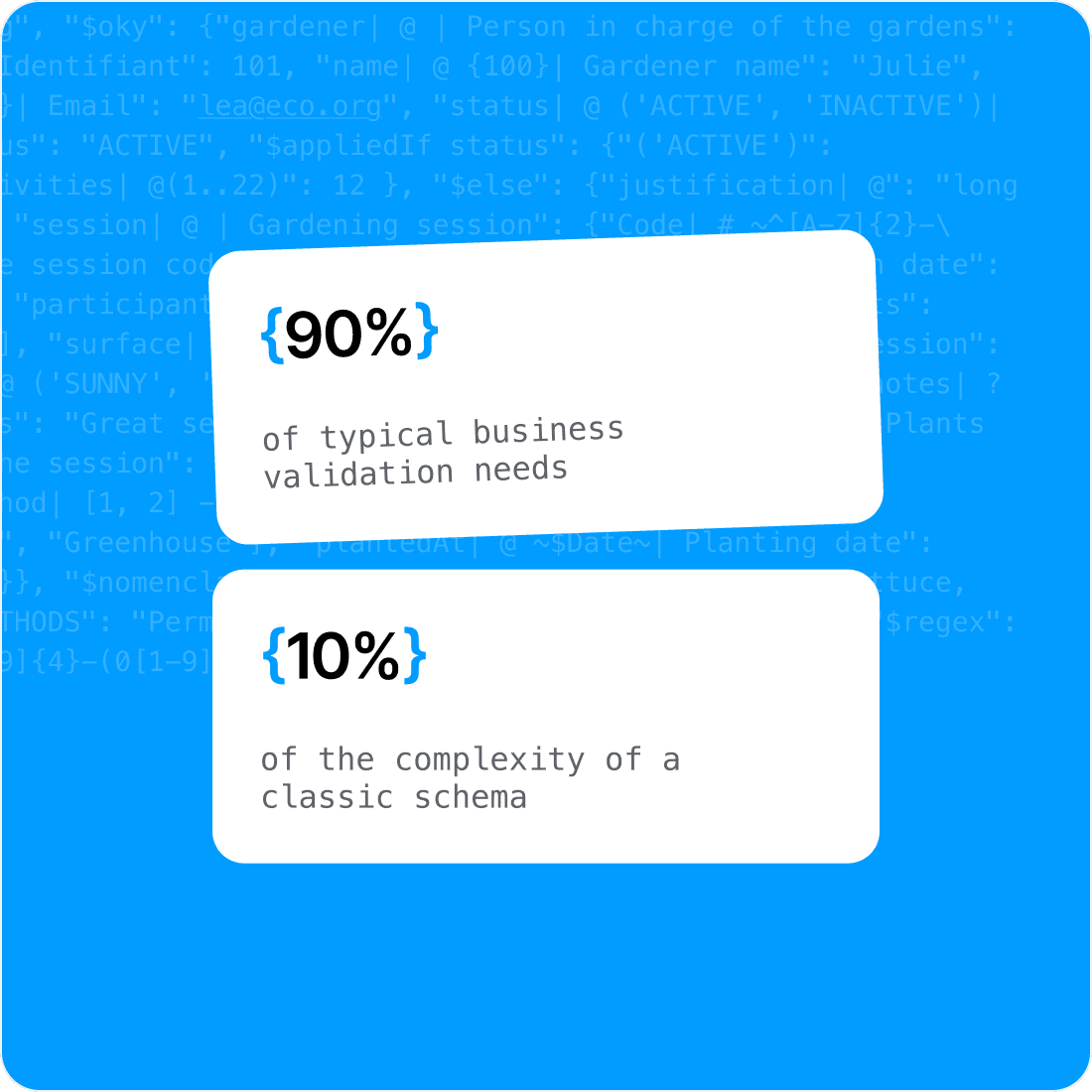
Cover 90% of real-world validations without writing schemas.
Smart type inference
What it does
Automatically detects string, number, boolean, etc.from your example
Real-world impact
No need to declare types manually — less boilerplate
Powerful collections
What it does
Unified syntax for lists and maps with [...] -> constraint
Real-world impact
Write rules for arrays and dictionaries in one consistent format
Reusable components
What it does
$ref, $nomenclature, $regex
Real-world impact
Modular, DRY, and maintainable models
Conditional logic
What it does
$requiredIf, $forbiddenIf, $appliedIf, and their...IfExist variants
Real-world impact
Simple business logical rules baked into the datalayer
Readable UI labels
What it does
Each field can include a human-readable label for docs or forms
Real-world impact
Generate doc pages or forms automatically
JSON Schema compatible
What it does
Okyline models can be transpiled to JSONSchema
Real-world impact
Plug into existing tooling ecosystems
No-code friendly
What it does
Human-first syntax, readable by non-devs
Real-world impact
Perfect for UI builders, documentation, and API design
Design-first syntax
What it does
Add validation rules directly inside exampleJSON fields using |suffixes|labels
Real-world impact
Your examples become specs. Instantlyreadable, immediately useful.
Design-first syntax
What it does
Add validation rules directly inside exampleJSON fields using |suffixes|labels
Real-world impact
Your examples become specs. Instantlyreadable, immediately useful.
Design-first syntax
What it does
Add validation rules directly inside exampleJSON fields using |suffixes|labels
Real-world impact
Your examples become specs. Instantlyreadable, immediately useful.
Field-levelconstraints
What it does
@, ?, (…), {…}, ~regex~, [min,max], !, $ref, %
Real-world impact
Cover 95% of real-world validations withoutwriting schemas
Field-levelconstraints
What it does
@, ?, (…), {…}, ~regex~, [min,max], !, $ref, %
Real-world impact
Cover 95% of real-world validations withoutwriting schemas
Field-levelconstraints
What it does
@, ?, (…), {…}, ~regex~, [min,max], !, $ref, %
Real-world impact
Cover 95% of real-world validations withoutwriting schemas
Design-first syntax
What it does
Automatically detects string, number, boolean, etc.from your example
Real-world impact
No need to declare types manually — lessboilerplate
Design-first syntax
What it does
Automatically detects string, number, boolean, etc.from your example
Real-world impact
No need to declare types manually — lessboilerplate
Design-first syntax
What it does
Automatically detects string, number, boolean, etc.from your example
Real-world impact
No need to declare types manually — lessboilerplate
Powerfulcollections
What it does
Unified syntax for lists and maps with [...] ->constraint
Real-world impact
Write rules for arrays and dictionaries in oneconsistent format
Powerfulcollections
What it does
Unified syntax for lists and maps with [...] ->constraint
Real-world impact
Write rules for arrays and dictionaries in oneconsistent format
Powerfulcollections
What it does
Unified syntax for lists and maps with [...] ->constraint
Real-world impact
Write rules for arrays and dictionaries in oneconsistent format
Reusablecomponents
What it does
$ref, $nomenclature, $regex
Real-world impact
Modular, DRY, and maintainable models
Reusablecomponents
What it does
$ref, $nomenclature, $regex
Real-world impact
Modular, DRY, and maintainable models
Reusablecomponents
What it does
$ref, $nomenclature, $regex
Real-world impact
Modular, DRY, and maintainable models
Conditional logic
What it does
$requiredIf, $forbiddenIf, $appliedIf, and their...IfExist variants
Real-world impact
Simple business rules baked into the datalayer
Conditional logic
What it does
$requiredIf, $forbiddenIf, $appliedIf, and their...IfExist variants
Real-world impact
Simple business rules baked into the datalayer
Conditional logic
What it does
$requiredIf, $forbiddenIf, $appliedIf, and their...IfExist variants
Real-world impact
Simple business rules baked into the datalayer
Readable UI labels
What it does
Each field can include a human-readable labelfor docs or forms
Real-world impact
Generate forms or doc pages automatically
Readable UI labels
What it does
Each field can include a human-readable labelfor docs or forms
Real-world impact
Generate forms or doc pages automatically
Readable UI labels
What it does
Each field can include a human-readable labelfor docs or forms
Real-world impact
Generate forms or doc pages automatically
JSON Schemacompatible
What it does
okyline models can be transpiled to JSONSchema
Real-world impact
Plug into existing tooling ecosystems
JSON Schemacompatible
What it does
okyline models can be transpiled to JSONSchema
Real-world impact
Plug into existing tooling ecosystems
JSON Schemacompatible
What it does
okyline models can be transpiled to JSONSchema
Real-world impact
Plug into existing tooling ecosystems
No-code friendly
What it does
Human-first syntax, readable by non-devs
Real-world impact
Perfect for UI builders, documentation, andAPI design
No-code friendly
What it does
Human-first syntax, readable by non-devs
Real-world impact
Perfect for UI builders, documentation, andAPI design
No-code friendly
What it does
Human-first syntax, readable by non-devs
Real-world impact
Perfect for UI builders, documentation, andAPI design
_Uncompromising simplicity#
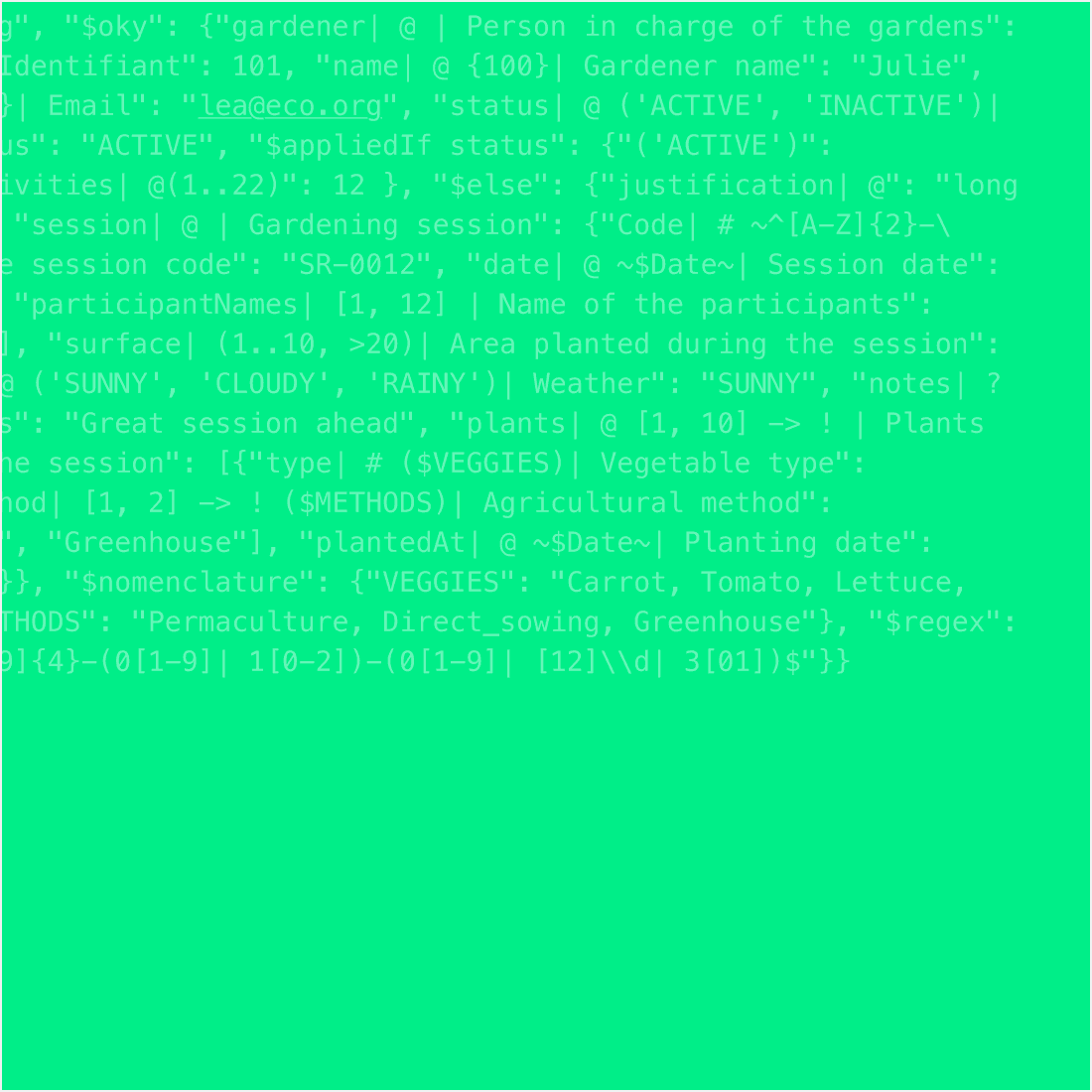
Okyline syntax combines simplicity and expressiveness. It fits into just a few characters while remaining human-readable and machine-usable.
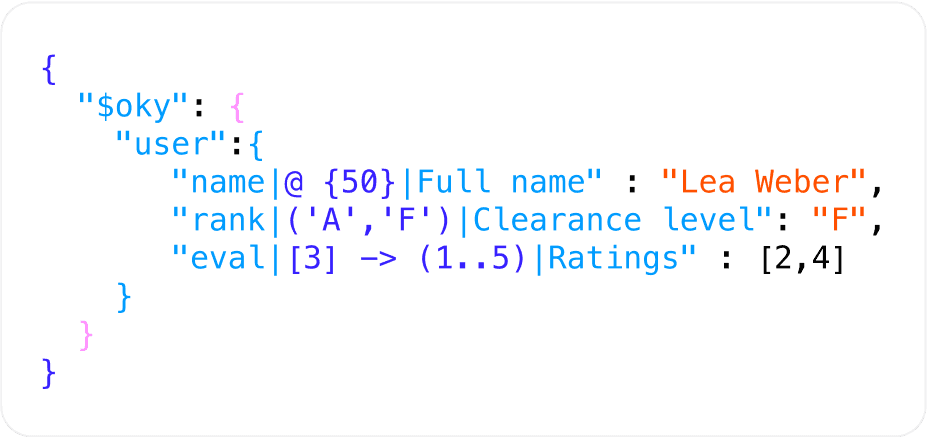
A simple JSON example is already a valid Okyline schema that defines the structure (field name, object, list, etc.) and the data type (infered from your data examples)
“
field name
|
suffixes
|
label
Okyline
JSON Schema

Simple & understandable schema

Okyline
JSON Schema

Simple & understandable schema

Okyline
JSON Schema

Simple & understandable schema

(...)
Value constraints
@
Required
?
Nullable
#
Key
[ , ]
List size
[ : ]
Map keys:size
~…~
Regex
$oneOf
!
Uniqueness
%
Default value
{…}
String lenght
->
Items constraints

(...)
Value constraints
@
Required
?
Nullable
#
Key
[ , ]
List size
[ : ]
Map keys:size
~…~
Regex
$oneOf
!
Uniqueness
%
Default value
{…}
String lenght
->
Items constraints
Why this syntax ?
You no longer read the constraints, you perceive them.
A symbolic syntax may seem surprising at first, but it is extremely effective.
The symbols act as visual cues : @ , ? , # , { ... } , ( ... ) , [ , ] are quicker to recognize than long, repetitive descriptions. This approach makes reading easier, reduces cognitive effort, and allows for immediate understanding of validation rules.
Typical use cases ?
Typical use cases ?
Typical use cases ?
For whom ?
For whom ?
For whom ?
Okyline suffixes & key words

Try Okyline now
Design and validate your schema, live, directly on your data - 100 % FREE

Try Okyline now
Design and validate your schema, live, directly on your data - 100 % FREE

Try Okyline now
Design and validate your schema, live, directly on your data - 100 % FREE